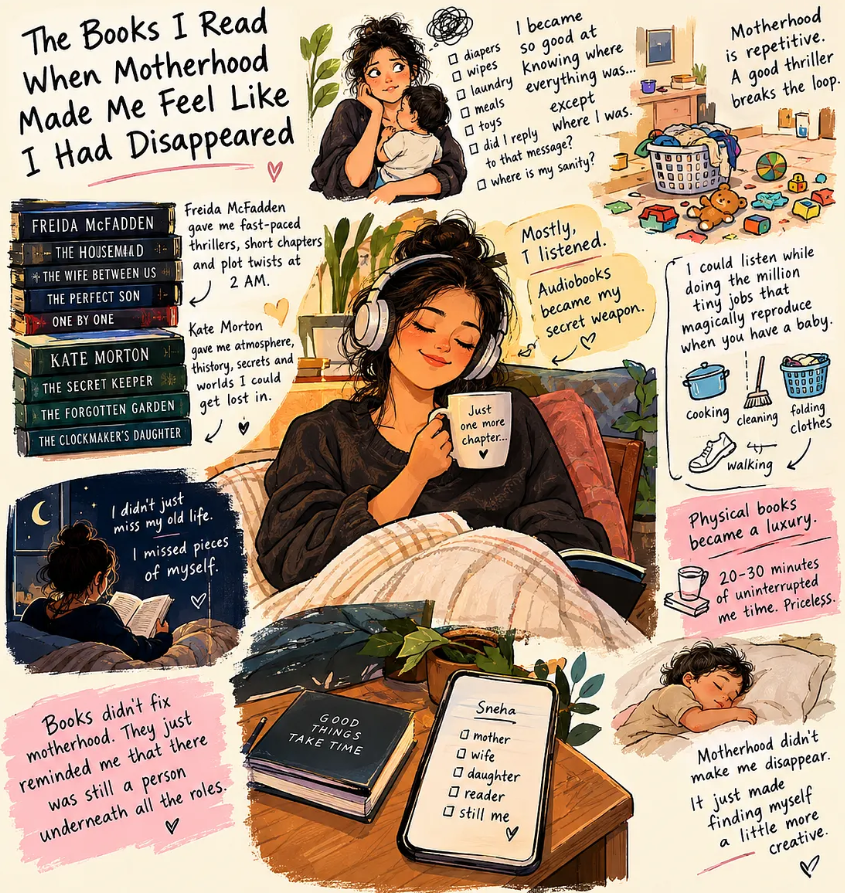
Motherhood didn’t make me disappear.
It just made finding myself a little more creative.
I became a mother and, somewhere along the way, became very good at knowing where everything was.
The diapers.
The wipes.
The extra clothes.
The baby’s favourite toy.
The bottle he had just used.
The thing he had thrown approximately three seconds ago.
What I became surprisingly bad at knowing was where I was.
Not physically.
I was usually somewhere between the kitchen, the bedroom and the baby’s room.
I mean me.
The woman who used to read because she wanted to.
The woman who could lose an entire afternoon inside a book and not feel guilty about it.
The woman who had opinions about authors, plot twists, and whether a book was worth finishing.
She hadn’t disappeared exactly.
She had just been buried under a mountain of laundry, responsibility and the strange mental gymnastics required to keep a small human alive.
So I started reading again.
Well.
Listening, mostly.
And, interestingly enough, I didn’t reach for gentle books about finding inner peace.
I reached for people being murdered.
Motherhood made me a thriller reader
There is something slightly amusing about the fact that one of the things that helped me feel like myself again was a fictional woman discovering that her husband was a psychopath.
But honestly, thrillers made sense.
Motherhood is repetitive in a way nobody really prepares you for.
You can have a wonderful day and still feel like you’ve lived the same day approximately 400 times.
Wake up.
Feed baby.
Clean something.
Feed baby.
Clean something else.
Wonder why there are crumbs everywhere when your child apparently ate nothing.
Feed baby.
Put toys away.
Find toys back on the floor.
Repeat.
A thriller breaks that loop.
Suddenly there are secrets.
Someone is lying.
Someone knows something they shouldn’t.
There is a locked room.
A suspicious neighbour.
A husband who is definitely hiding something.
And I am sitting there thinking:
Finally. A problem I don’t have to solve in real life.
Freida McFadden became my guilty pleasure
I found myself gravitating towards Freida McFadden quite a bit.
Her books are incredibly easy to get into, which is exactly what I needed.
Because my attention span had changed.
Not permanently, I hope.
But motherhood had turned my brain into something resembling a browser with 47 tabs open.
One tab was the baby.
One was food.
One was laundry.
One was something I had forgotten.
One was Did I reply to that message?
And somewhere in the background, one tab was screaming.
So I needed books that didn’t demand too much from me before they became interesting.
Freida’s short chapters and fast pacing helped.
I could listen for ten minutes and immediately feel like I had gone somewhere.
And her books are very good at creating that just one more chapter feeling.
Which is slightly inconvenient when you have a child.
Because suddenly you’re standing in the kitchen at 11:45 p.m. thinking:
I should really go to bed.
And your audiobook says:
But here’s another plot twist.
And now you have made a terrible decision.
You continue listening.
Obviously.
Kate Morton gave me somewhere else to live
Kate Morton was different.
Her books pulled me in more slowly.
There were old houses, family histories, secrets that had been buried for years, relationships shaped by things nobody talked about and stories that moved between different periods of time.
I loved that.
There is something incredibly immersive about a Kate Morton novel.
You don’t just want to know what happened.
You want to understand the people.
The house.
The history.
The thing everyone has been avoiding.
You start carrying the atmosphere of the book around with you.
And I think that was particularly appealing to me as a new mother.
Because my world had become very immediate.
What does he need?
When did he last eat?
Is he sleepy?
Why is he crying?
Where did he put that?
Why is he putting that in his mouth?
There wasn’t much room for mystery.
Kate Morton gave me mystery again.
I could be standing in my kitchen in India, listening to a story set decades ago somewhere completely different, while my actual life continued around me.
For a little while, I wasn’t someone’s mother.
I was just a reader.
And I really missed being her.
Audiobooks saved my reading life
I used to think listening to a book somehow didn’t count as reading.
I have officially withdrawn that opinion.
Motherhood humbled me.
Audiobooks became my secret weapon.
I could listen while doing things that required my hands but not necessarily all of my brain.
Cooking.
Cleaning.
Folding clothes.
Walking.
Doing the million tiny jobs that seem to magically reproduce when you become responsible for another human being.
And suddenly those chores weren’t quite as monotonous.
I had a story playing in my ears.
Someone was telling me about a murder while I was folding tiny socks.
Honestly, motherhood is weird.
But this particular kind of weird worked for me.
The audiobook became this little private world that travelled with me.
Nobody could see it.
Nobody needed anything from it.
It was mine.
Physical books became a luxury
I still love physical books.
There is something about holding a real book that an audiobook can’t replicate.
But now, a physical book comes with a very specific requirement:
I need to have 20–30 minutes where nobody needs me.
That is a surprisingly expensive luxury.
And when I say 20–30 minutes, I mean actual 20–30 minutes.
Not:
“Baby is sleeping, I’ll read.”
Because the moment you open the book, the baby wakes up.
Not:
“I’ll just sit down for a bit.”
Because suddenly you remember there is laundry in the washing machine.
Not:
“I have the house to myself.”
Because apparently the universe hears that sentence and takes it personally.
So when I actually get those twenty or thirty minutes, I guard them.
I make a cup of something.
I pick up my physical book.
And I read.
No multitasking.
No feeling productive.
No trying to squeeze something else into the time.
Just reading.
It feels almost rebellious.
I didn’t realise how much I needed something that was just mine
This is the part about motherhood that I think we don’t talk about enough.
You don’t necessarily miss your old life.
You miss pieces of yourself.
You can love your child more than you knew it was possible to love another human being and still miss the person you were before them.
You can be happy and exhausted.
Grateful and overwhelmed.
Completely in love with your life and occasionally desperate for ten minutes in which nobody says “Mummy.”
All of those things can be true.
At the same time.
And I think books helped me hold those contradictions.
They gave me a tiny piece of my old identity without asking me to leave my new one behind.
I didn’t have to choose between being a mother and being a reader.
I could be both.
Even if the reading happened through headphones while I was cleaning the kitchen.
Even if it took me three weeks to finish a physical book.
Even if I had to pause an audiobook because my toddler suddenly decided that the most urgent thing in the world was showing me a random object he had found on the floor.
Maybe disappearing into a book isn’t really disappearing
I used to think escaping into a book meant temporarily getting away from real life.
Now I see it differently.
Sometimes you don’t read because you want to escape your life.
Sometimes you read because you want to return to yourself.
For those few minutes, nobody needs anything from me.
I don’t have to make a decision.
I don’t have to remember anything.
I don’t have to be productive.
I don’t have to be somebody’s mother, somebody’s wife, somebody’s daughter, somebody’s employee.
I can just be Sneha.
The girl who likes thrillers.
The woman who gets unnecessarily invested in fictional people’s terrible decisions.
The reader who will absolutely say one last chapter and then regret it the next morning.
And maybe that’s why these books mattered more than I expected them to.
They didn’t fix motherhood.
They didn’t make me less tired.
They didn’t magically create more time.
They simply reminded me that there was still a person underneath all the roles.
She’s still here.
She’s just sometimes wearing headphones, folding laundry and listening to someone uncover a twenty-year-old murder.
And honestly?
I’ll take that.
Because motherhood didn’t make me disappear.
It just made finding myself a little more creative.


Leave a comment