I didn’t expect motherhood to make me question myself this much.
Not the big questions.
The small ones.
Am I feeding him enough?
Am I holding him too much?
Should I let him cry for a little while?
Why is he crying when he was perfectly happy five minutes ago?
Should I be doing things differently?
And, perhaps the most exhausting question of all:
Am I actually a good mother?
The first year of motherhood is strange that way.
You can be completely in love with your baby and still feel like you’re constantly getting something wrong.
And sometimes, the people who are supposed to make those first few months easier can unintentionally make you feel even smaller.
For me, that was one of the hardest parts of becoming a mother.
Nobody tells you how vulnerable a new mother is
When your baby is born, everyone asks about the baby.
How much does he weigh?
Is he sleeping?
Is he feeding well?
Did he burp?
Did he poop?
Is he crying?
But very few people ask the mother a simple question:
“How are you doing?”
And even when they do, sometimes they’re not really asking.
They’re checking whether you’re coping.
Because somehow, once you become a mother, you’re expected to cope.
You’re tired? Everyone is tired.
You’re overwhelmed? That’s motherhood.
You’re worried? Don’t worry so much.
You’re confused? Someone older knows better.
You’re crying? Hormones.
You’re irritated? You’re probably not sleeping enough.
You’re doing something differently from how they did it thirty years ago?
Well, that’s when the unsolicited advice begins.
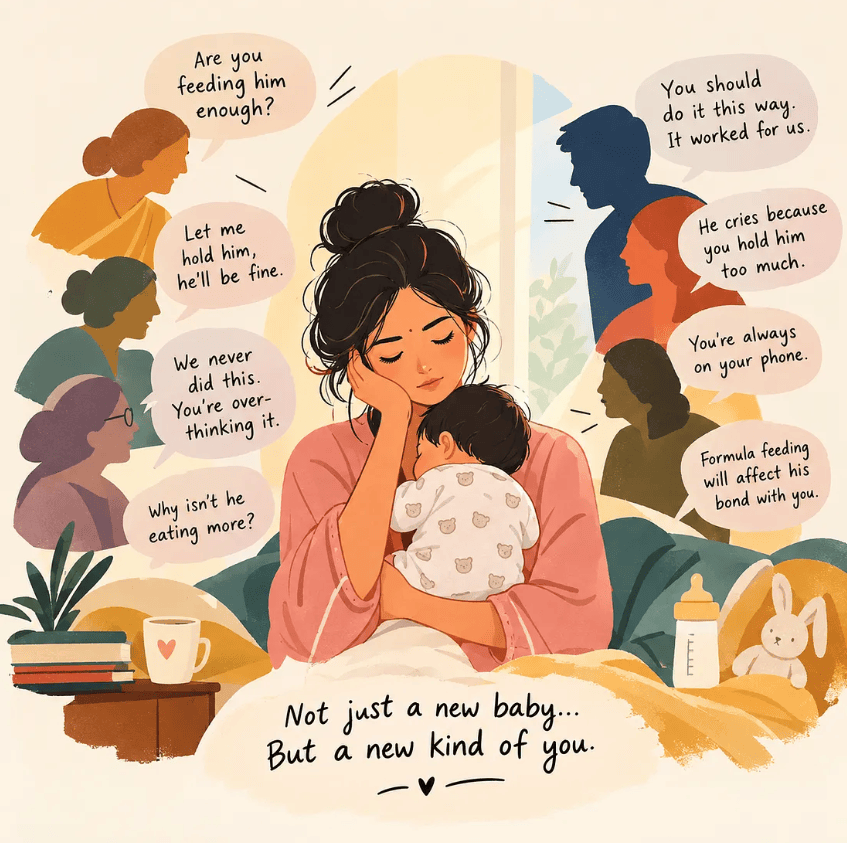
And in an Indian family, especially a joint or closely connected family, motherhood can quickly become a community project.
Everyone has an opinion.
Everyone has a story.
Everyone knows a baby who slept better, ate better, gained weight faster, cried less, walked earlier or was raised without any of the things you’re currently doing.
And somehow, you’re standing there with your three-month-old baby, surviving on broken sleep, wondering why everyone seems to have received the motherhood manual except you.
Sometimes it isn’t the advice. It’s how the advice makes you feel.
I don’t think advice is inherently bad.
Grandmothers know things.
Mothers-in-law know things.
Older women have raised children before us.
There is enormous wisdom in that.
But wisdom becomes difficult to receive when it comes wrapped in judgment.
There is a difference between:
“Have you tried doing it this way? It helped us when our children were little.”
and:
“We never did this. That’s why our children turned out fine.”
The first one gives you an option.
The second one quietly tells you that you’re doing something wrong.
And when you’re already exhausted, you don’t always have the emotional strength to separate the two.
A comment that might seem harmless to someone else can stay inside a new mother’s head for hours.
Sometimes days.
You replay it while feeding the baby.
You think about it while washing bottles.
You remember it at 2 a.m. when the baby wakes up.
You wonder whether they were right.
Maybe I am overfeeding him.
Maybe I’m holding him too much.
Maybe I’m not strict enough.
Maybe I’m too anxious.
Maybe I’m not producing enough milk.
Maybe I should be doing what they did.
Maybe I’m just not good at this.
And that last thought is the dangerous one.
There were moments when I felt like a guest in my own motherhood.
This is perhaps the hardest thing I’ve struggled to explain.
It wasn’t that I didn’t love the people around my baby.
I did.
It wasn’t that I didn’t appreciate their love for him.
I did that too.
But sometimes, when everyone wanted to hold him, feed him, soothe him or tell me what he needed, I felt strangely displaced.
I was his mother.
But there were moments when I felt as though I had to ask permission to behave like one.
If he cried in someone else’s arms, I wanted to take him.
Sometimes I would hesitate.
Would they think I’m being possessive?
Would they think I don’t trust them?
Would someone say, “Let him be, he’ll stop crying”?
And there I would be, standing a few feet away from my own baby, trying to decide whether following my instinct would make me look unreasonable.
Nobody had to explicitly tell me that I was doing something wrong.
Sometimes the atmosphere was enough.
That is what people don’t always understand about emotional pressure.
It doesn’t always come in the form of shouting.
Sometimes it’s a look.
A sigh.
A comparison.
A sarcastic comment.
An unnecessary correction.
Or simply the feeling that whatever you do will be evaluated.
And then there are the comparisons.
Indian families have a remarkable ability to turn babies into tiny statistical projects.
“He should be doing this by now.”
“My children never cried this much.”
“Our babies didn’t need so much attention.”
“You should try this.”
“Why isn’t he eating more?”
“Why are you feeding him that?”
“Why don’t you do it the way we did?”
The irony is that babies aren’t standardized products.
Neither are mothers.
Two babies can be born into the same family and have completely different temperaments.
Two mothers can have completely different experiences of pregnancy, birth, recovery, feeding, sleep deprivation and anxiety.
And yet new mothers are constantly compared to somebody else’s motherhood.
I think that’s especially painful during the first year because you haven’t found your footing yet.
You’re still becoming a mother.
You don’t wake up one morning with a certificate saying:
Congratulations. You now know what you’re doing.
You learn your baby slowly.
You learn their cries.
Their expressions.
Their sleepy face.
Their strange little noises.
You learn what comforts them.
You learn what scares them.
And, somewhere along the way, you begin learning yourself too.
You discover that you are more patient than you thought.
More tired than you imagined.
More emotional than you expected.
And stronger than you knew you could be.
That process needs space.
Sometimes a mother doesn’t need another person taking over.
She needs someone saying,
“You’re doing okay.”
That sentence can do more for a new mother than ten instructions.
Because motherhood already comes with enough doubt.
There are doctors.
There are parenting books.
There are Instagram reels.
There are WhatsApp groups.
There are relatives.
There are strangers in supermarkets.
Everyone has something to say.
But very few people say:
“I trust you.”
And perhaps that’s what I needed most.
Not someone to tell me that every decision I made was perfect.
I know it wasn’t.
I am a first-time mother. I make mistakes.
But I needed people around me to understand that making a mistake doesn’t mean I am an incompetent mother.
I needed room to learn.
Room to make decisions.
Room to change my mind.
Room to hold my baby when I felt like holding him.
Room to say no without having to justify it.
Room to be tired without being made to feel guilty.
Room to be his mother without constantly feeling like I was appearing for an examination.
The first year changes you in ways nobody sees.
People talk about the baby turning one.
They celebrate the first birthday.
The first steps.
The first words.
The first tooth.
But there is another first birthday happening quietly.
The mother you were on the day your baby was born is not the woman standing there twelve months later.
She’s been through sleepless nights.
Feeding struggles.
Doctor visits.
Recovery.
Hormones.
Fear.
Guilt.
Loneliness.
Tiny victories.
And a thousand moments where she wondered if she was enough.
Maybe she cried in the bathroom so nobody would see.
Maybe she ate lunch at 4 p.m.
Maybe she drank the same cup of tea three times because every time she tried to finish it, the baby woke up.
Maybe she smiled at everyone while quietly falling apart.
Maybe she heard someone’s comment and pretended it didn’t hurt.
It did.
Of course it did.
She was already carrying so much.
I have also learned that boundaries are not disrespect.
This has been a difficult lesson for me because Indian families often teach us that respecting elders means accommodating them.
Sometimes it does.
But motherhood taught me that respect cannot mean disappearing.
I can respect someone and still say no.
I can appreciate someone’s experience and still choose differently.
I can love my in-laws and still need boundaries with them.
I can understand that they love my child and still say, “I’d like to handle this myself.”
I can listen to advice without accepting every piece of it.
And most importantly, I can remember that being the mother doesn’t make me selfish.
It makes me responsible for my relationship with my child.
There is a difference.
I don’t want my child to grow up watching me disappear.
Maybe that’s the biggest thing I’ve taken away from this first year.
I don’t want my son to grow up believing that love means constantly silencing yourself.
I don’t want him to think that keeping everyone happy is more important than being honest about what you need.
I want him to see a mother who loves her family but also knows where she ends and another person begins.
A mother who can say, “I don’t agree.”
A mother who can change her mind.
A mother who can apologize when she’s wrong.
A mother who can stand up for herself without hating anyone.
Because one day, my little boy will become an adult.
And I hope the woman he remembers as his mother isn’t someone who spent all her years trying to prove that she was good enough.
I hope he remembers someone who loved him fiercely.
Someone who learned.
Someone who sometimes got things wrong.
Someone who laughed loudly.
Someone who cried.
Someone who had boundaries.
Someone who slowly found her voice.
And perhaps that’s what the first year of motherhood really is.
Not just raising a baby.
It’s learning to become a mother without losing the woman who existed before you became one.
And sometimes, the hardest part isn’t the baby.
It’s finding the courage to believe that your voice belongs in the room, too.


Leave a comment